

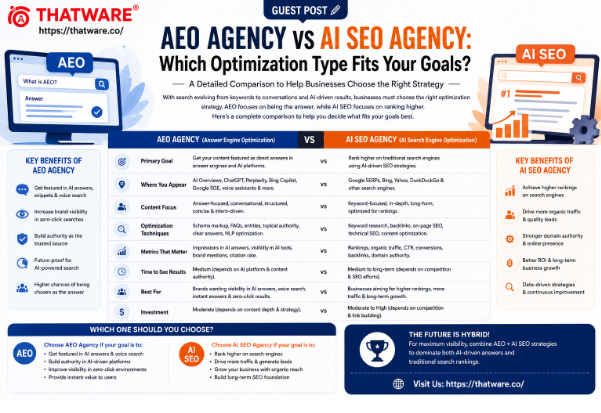
The alphabet soup of SEO-adjacent disciplines keeps expanding. SEO, AEO, GEO, SGE, E-E-A-T — keeping track of what these terms mean and how they relate to each other is genuinely confusing, even for people who work in digital marketing professionally. And as agencies proliferate around each category, the confusion deepens.
Let’s specifically unpack two that get conflated frequently: AEO (Answer Engine Optimization) and AI SEO. They’re related. They’re not the same. And understanding the difference has practical implications for which type of agency you should be talking to, depending on what you’re actually trying to accomplish.
What AEO Actually Is
Answer Engine Optimization is focused on getting your content featured in “answer” placements — featured snippets, People Also Ask boxes, Knowledge Panel content, and increasingly, AI Overview summaries in Google search results. The goal is to have your content be the direct answer to a query, rather than just a result that leads to an answer.
AEO practices include: structured content formatted to match answer patterns (definitions, step-by-step processes, comparison tables), schema markup that helps search engines classify and surface content, question-and-answer formatting, and content conciseness designed for direct extraction.
An AEO agency (Answer Engine Optimization) typically specializes in optimizing existing content for answer placements, building new content specifically designed to capture featured snippets, and implementing structured data that facilitates extraction and display.
What AI SEO Is
AI SEO is broader. It’s not just about answer placements — it’s about using AI-informed methodology to improve organic search performance comprehensively: faster ranking velocity, broader query coverage, more durable ranking positions, and increasingly, visibility in AI-generated search responses.
AI SEO includes some AEO practices — answer-formatted content and structured data are useful for AI search visibility — but the scope is significantly wider. AI SEO agencies do semantic entity mapping, probabilistic intent modeling, content graph architecture, behavioral signal engineering, and strategic competitive analysis using machine learning. The AEO piece is a component, not the whole.
When AEO Is the Right Focus
There are situations where AEO-specific work is the highest priority:
When you’re already ranking but not capturing answer placements. If your pages are in positions three to eight and you want to move to position zero (featured snippet), AEO-specific optimization of existing content is more efficient than a broader AI SEO engagement.
When voice search or smart speaker visibility matters for your business. Voice search results are almost exclusively pulled from answer placements — featured snippets and structured answers. If your audience is skewing toward voice search (increasingly true in certain verticals), AEO is specifically relevant.
When you’re trying to capture AI Overview traffic specifically. As AI Overviews become a larger share of search result pages, content designed to be cited in AI Overview answers requires AEO-style formatting and structured data.
When AI SEO Is the Right Focus
When you’re trying to rank faster, for more queries, with more durability. This is the core AI SEO value proposition — not just capturing answer placements, but building semantic authority that accelerates ranking across your full target query set.
When you have significant content volume that lacks coherent architecture. A large content library that exists in semantic isolation benefits from the architectural work of AI SEO, which AEO can’t address.
When you’re competing against established players in a dense semantic landscape. Entity-level competitive positioning requires AI SEO’s semantic mapping capabilities, not just AEO formatting.
When your organic search goals span multiple query types and buyer journey stages. AEO is primarily about answer-format queries. AI SEO addresses the full spectrum.
The Overlap and the Hybrid Argument
Here’s where it gets interesting: the best best agency for AI search optimization approaches in 2026 don’t choose between AEO and AI SEO. They integrate both.
The semantic entity mapping and content graph architecture of AI SEO creates the foundational authority that makes AEO placements possible. AEO-style formatting of specific content pieces — designed to be extracted and displayed as answers — works better when those pieces exist within a coherent semantic ecosystem that reinforces Google’s confidence in their authority.
The agencies worth working with understand this integration. Agencies that sell AEO and AI SEO as entirely separate offerings — with separate pricing and separate teams — are probably not thinking about this holistically enough.
Making the Call for Your Situation
A practical decision guide:
If you have limited budget and the specific goal of capturing more answer placements for content that already ranks, start with AEO. It’s more targeted and can show results faster.
If you have an established organic presence and want to accelerate ranking velocity across new content, AEO alone won’t get you there. AI SEO is the right framework.
If you’re building an organic strategy from a relatively early stage, integrate both from the start rather than treating them sequentially. The compounding benefit of semantic architecture with answer-optimized content is greater than either in isolation.
And if an agency claims significant expertise in one of these areas but has only a vague understanding of the other, that’s a signal that their overall thinking about modern search isn’t as integrated as it should be. The landscape has evolved to the point where genuine expertise in organic search visibility requires holding both frameworks simultaneously.
The terminology will keep evolving. The underlying principles — build semantic authority, resolve genuine user intent, format for extractability, measure comprehensively — are stable. Choosing an agency based on those principles, rather than on which acronym they’re currently leading with, will serve you better.