

In the high-octane world of Bollywood, where massive box office collections often translate into widespread critical and audience acclaim, veteran actor Mohan Kapur has offered a refreshingly candid perspective on one of the biggest cinematic successes of recent times. While acknowledging the technical brilliance and powerful performances in Dhurandhar, Kapur has publicly questioned the overwhelming hype surrounding the Ranveer Singh-starrer, reminding audiences and fans that the film, despite its gripping narrative and commercial triumph, is ultimately a work of fiction.
Dhurandhar, directed by Aditya Dhar, emerged as a blockbuster, delivering high-octane action, sharp espionage thrills, and strong ensemble performances featuring Ranveer Singh in the lead alongside Akshaye Khanna and others. The film, and its sequel, shattered several box office records, cementing Ranveer’s status as a versatile star capable of shouldering big-budget spectacles. Yet, in the midst of universal praise and celebratory discourse, Mohan Kapur chose to strike a note of caution and realism.
Appreciating Craft While Grounding Expectations
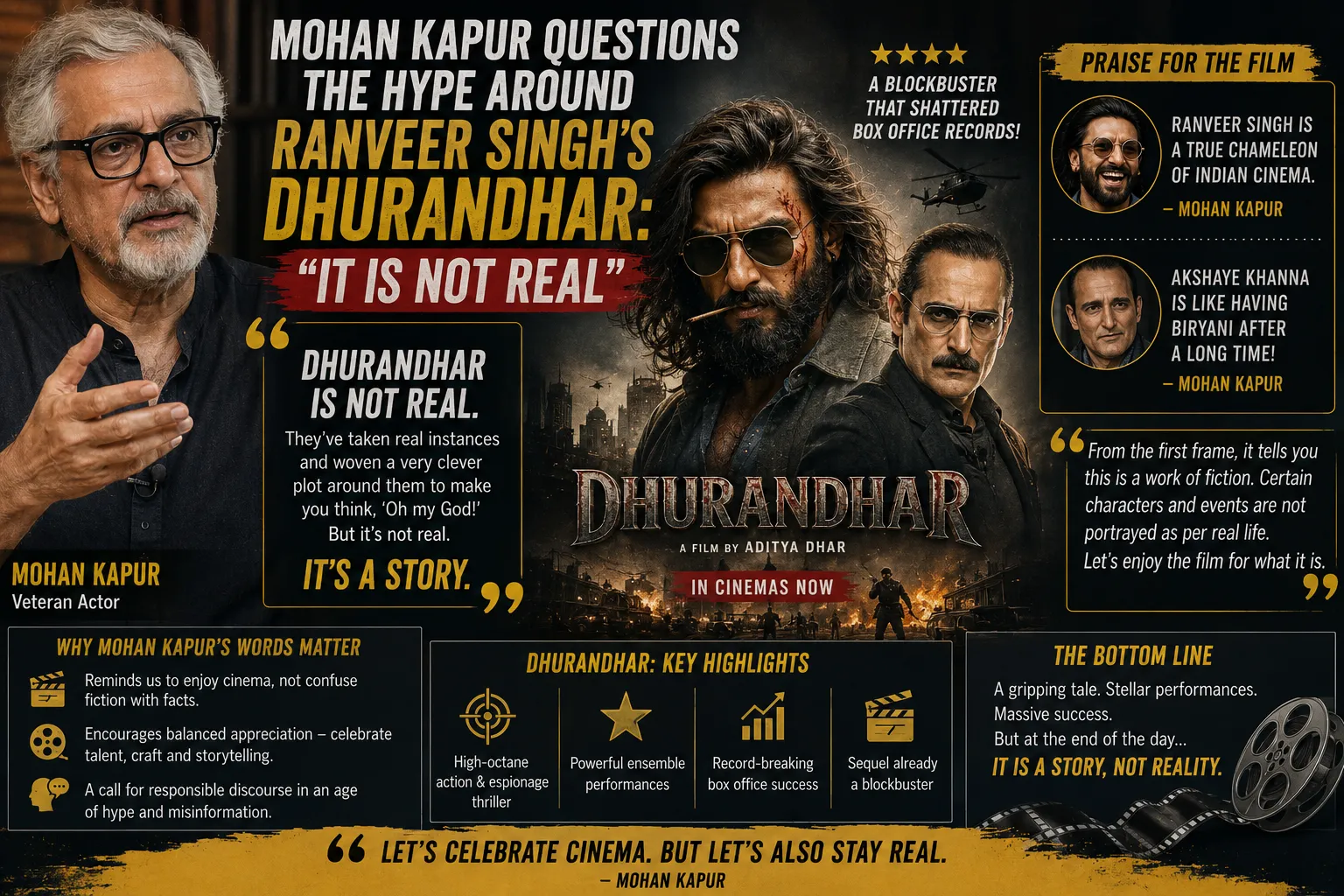
Mohan Kapur, known for his measured and thoughtful views on cinema, did not hold back on praising the film’s strengths. He lauded Ranveer Singh’s transformative abilities, describing him as a “true chameleon” of Indian cinema, and highlighted Akshaye Khanna’s performance as a refreshing treat. Kapur compared watching Khanna deliver a powerful role to “having biryani after a long time,” underscoring the actor’s enduring class and screen presence.
However, Kapur drew a clear line when it came to the film’s reception. He expressed bewilderment at the intense hype and near-mythical status the movie seemed to acquire in public conversations. “Dhurandhar is not real,” he stated plainly. Kapur pointed out that the story cleverly weaves in real-life inspirations and events but constructs an entirely fictional premise around them. From the opening frames, he noted, the narrative signals its invented nature, particularly through certain character portrayals that diverge from historical or factual accuracy.
“It’s a story,” Kapur emphasised. “They’ve taken real instances and woven a very clever plot around them to make you think, ‘Oh my God!’ But it’s not real.” This distinction, according to him, is important in an era where audiences and media sometimes blur the lines between cinematic fiction and documentary-style representation, especially in spy thrillers and biopics-adjacent films.
The Power and Perils of Cinematic Hype
Mohan Kapur’s comments arrive at a time when Bollywood is witnessing renewed success with high-concept, mass-appeal entertainers. Dhurandhar benefited from strong word-of-mouth, spectacular action sequences, and Ranveer Singh’s magnetic screen presence, which helped it achieve extraordinary commercial heights. Such success naturally generates massive buzz, social media trends, and industry-wide celebration.
Yet, Kapur’s intervention highlights a crucial aspect of film appreciation: separating artistic enjoyment from factual endorsement. In spy-action genres, filmmakers often draw from real geopolitical tensions, intelligence operations, and historical contexts to lend authenticity and emotional weight. When executed well, this technique creates immersive experiences that resonate deeply with viewers. However, as Kapur rightly notes, the final product remains a dramatised, fictionalised account designed for entertainment rather than education or historical documentation.
This perspective is particularly relevant in today’s media landscape, where viral marketing, fan communities, and 24/7 digital discourse can sometimes elevate films to disproportionate cultural or ideological significance. Kapur’s stance serves as a gentle reminder to enjoy cinema for what it is — a compelling story told through powerful performances and technical excellence — without assigning it undue real-world weight.

Ranveer Singh’s Chameleon-like Versatility
Despite his reservations about the hype, Kapur was generous in his praise for Ranveer Singh. The actor’s ability to disappear into diverse roles has been a consistent highlight of his career, and Dhurandhar provided yet another showcase for his range. From intense dramatic moments to high-energy action, Ranveer delivered a performance that contributed significantly to the film’s appeal.
Kapur’s “chameleon” remark acknowledges this versatility, positioning Ranveer among the most adaptable stars of his generation. This appreciation from a senior actor adds credibility and warmth to the conversation, showing that professional critique need not diminish genuine admiration for talent.
Broader Implications for Film Discourse
Mohan Kapur’s remarks open up a larger dialogue about how Bollywood films are received and discussed. In an industry often criticised for formulaic storytelling or exaggerated claims, voices that advocate for balanced appreciation play a valuable role. They encourage audiences to celebrate creativity, direction, acting, and technical achievements while maintaining a healthy distinction between reel and real.
For filmmakers and producers, such feedback can also serve as constructive guidance. While commercial success is vital, grounding narratives and managing expectations around their “inspirational” or “based on true events” elements can lead to more transparent and satisfying viewer experiences.
Furthermore, in an age of franchise filmmaking — with Dhurandhar already spawning a successful sequel — maintaining clarity about fictional liberties becomes even more important to preserve long-term credibility and audience trust.
Celebrating Cinema Responsibly
Mohan Kapur’s honest take does not detract from Dhurandhar’s achievements. The film delivered grand entertainment, memorable performances, and box office glory, proving that original, high-concept Hindi cinema still holds strong appeal. Ranveer Singh’s star power, combined with Aditya Dhar’s vision, created a robust franchise with pan-Indian and international resonance.
At the same time, Kapur’s candour reinforces a mature approach to film consumption. Audiences can revel in the thrills, emotions, and spectacle while recognising that cinema, at its core, is an art form built on imagination and storytelling craft.
In an industry where hype cycles move rapidly, voices like Mohan Kapur’s bring balance and perspective. They remind us that the greatest films often succeed not by claiming absolute truth, but by telling compelling stories that move, entertain, and occasionally provoke thought — even if they are, as he succinctly put it, “not real.”
As Bollywood continues its journey of reinvention through big-screen spectacles and character-driven narratives, such discerning commentary enriches the ecosystem. It encourages both creators and viewers to value substance, honesty, and artistic merit over manufactured frenzy, ensuring that the love for cinema remains grounded, joyful, and sustainable for years to come.
presslyy presslyy presslyy presslyy presslyy presslyy presslyy presslyy presslyy presslyy presslyy presslyy presslyy presslyy presslyy presslyy presslyy presslyy presslyy presslyy presslyy presslyy presslyy presslyy presslyy presslyy presslyy presslyy presslyy presslyy presslyy presslyy presslyy presslyy presslyy presslyy presslyy presslyy presslyy presslyy presslyy presslyy presslyy presslyy presslyy presslyy presslyy presslyy presslyy presslyy presslyy presslyy presslyy presslyy presslyy presslyy presslyy presslyy presslyy presslyy presslyy presslyy presslyy presslyy presslyy presslyy presslyy presslyy presslyy presslyy presslyy presslyy presslyy presslyy presslyy presslyy presslyy presslyy presslyy presslyy presslyy presslyy presslyy presslyy presslyy presslyy presslyy presslyy presslyy presslyy presslyy presslyy presslyy presslyy presslyy presslyy presslyy presslyy presslyy presslyy presslyy presslyy presslyy presslyy presslyy presslyy presslyy presslyy presslyy presslyy presslyy presslyy presslyy presslyy presslyy presslyy presslyy presslyy presslyy presslyy presslyy presslyy presslyy presslyy presslyy presslyy presslyy presslyy presslyy presslyy presslyy presslyy presslyy presslyy presslyy presslyy presslyy presslyy presslyy presslyy presslyy presslyy presslyy presslyy presslyy presslyy presslyy presslyy presslyy presslyy presslyy presslyy presslyy presslyy presslyy presslyy presslyy presslyy presslyy presslyy presslyy presslyy presslyy presslyy presslyy presslyy presslyy