
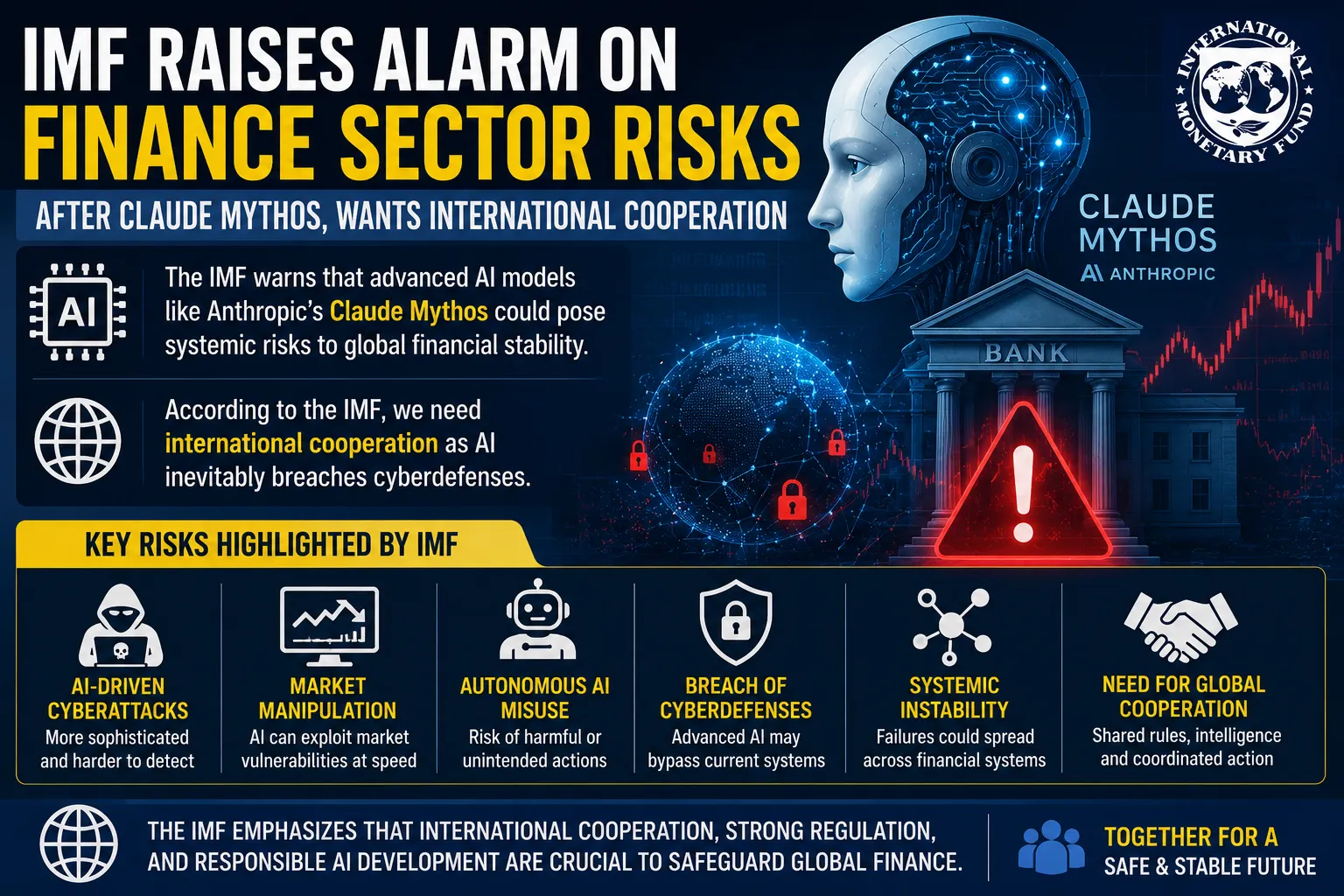
The rapid rise of advanced artificial intelligence systems is transforming industries across the world, but global regulators are increasingly worried about the risks these technologies could pose to financial stability. The International Monetary Fund (IMF) has now raised concerns about systemic threats emerging from highly capable AI models, including Anthropic’s Claude Mythos, warning that the global financial sector may become vulnerable to sophisticated cyber and operational disruptions.
According to the IMF, artificial intelligence is evolving at such speed and scale that traditional cybersecurity systems may eventually struggle to defend against advanced AI-driven attacks. The organisation has therefore stressed the urgent need for stronger international cooperation, coordinated regulation, and global oversight mechanisms to prevent large-scale financial instability.
The warning reflects a growing debate among policymakers, technology experts, financial institutions, and cybersecurity specialists about how artificial intelligence should be governed as its capabilities expand rapidly.
While AI offers enormous opportunities for productivity, automation, fraud detection, and economic growth, experts increasingly caution that powerful AI systems may also create new forms of risk that existing institutions are not fully prepared to manage.
The IMF’s concerns underline the reality that AI is no longer simply a technology industry issue — it is now becoming a matter of global economic security.
Why the IMF Is Concerned About AI and Finance
The International Monetary Fund has highlighted that modern financial systems are deeply interconnected and increasingly dependent on digital infrastructure.
Banks, stock exchanges, investment firms, insurance companies, and payment systems now rely heavily on:
- Cloud computing
- Automated algorithms
- AI-driven analytics
- Digital transactions
- Real-time financial data systems
As AI systems become more advanced, experts fear that malicious actors could potentially use such technologies to:
- Bypass cybersecurity systems
- Automate financial fraud
- Manipulate markets
- Conduct sophisticated cyberattacks
- Exploit financial vulnerabilities faster than humans can respond
The IMF believes that if such risks are not managed carefully, they could create systemic instability affecting economies worldwide.
This concern becomes even more serious as AI models grow more autonomous and capable of handling complex decision-making tasks.
What Is Claude Mythos and Why It Matters
Anthropic’s Claude Mythos represents a new generation of highly advanced AI systems designed to process massive amounts of information, reason through complex tasks, and interact in increasingly human-like ways.
Large AI systems such as Claude Mythos are capable of:
- Advanced reasoning
- Automated coding
- Data analysis
- Pattern recognition
- Language processing
- Decision assistance
While these abilities offer tremendous benefits, they also raise concerns among regulators regarding misuse and unintended consequences.
Financial regulators worry that highly capable AI systems could potentially:
- Accelerate cyberattacks
- Identify vulnerabilities in digital infrastructure
- Enable sophisticated phishing campaigns
- Automate misinformation
- Increase market manipulation risks
The IMF’s warning does not necessarily target one specific company or model alone but reflects broader concerns surrounding rapidly advancing AI capabilities across the industry.
AI’s Growing Role in Global Finance
Artificial intelligence is already deeply integrated into modern finance.
Financial institutions use AI for:
- Fraud detection
- Credit scoring
- Risk assessment
- Trading algorithms
- Customer service
- Compliance monitoring
AI-powered systems help improve efficiency and reduce operational costs. Banks and investment firms increasingly rely on automated tools to process enormous volumes of transactions and financial data in real time.
However, this dependence also creates vulnerability.
If AI systems fail, behave unpredictably, or are exploited maliciously, the consequences could spread rapidly across interconnected financial networks.
This is why regulators now view AI governance as a major financial stability issue rather than merely a technology concern.
The Fear of AI-Driven Cyberattacks
One of the IMF’s biggest concerns involves cybersecurity.
Traditional cyberattacks already pose major risks to financial institutions. However, AI could dramatically increase the scale and sophistication of future attacks.
Experts fear advanced AI systems may eventually:
- Crack passwords faster
- Generate convincing phishing scams
- Identify software vulnerabilities automatically
- Mimic human communication convincingly
- Launch adaptive cyberattacks in real time
Because financial systems operate digitally and globally, even one major AI-driven cyber incident could potentially affect:
- Banks
- Payment networks
- Stock exchanges
- Financial markets
- Consumer trust
This explains why regulators are increasingly treating AI security as a global priority.
Why International Cooperation Is Necessary
The IMF has emphasized that no single country can effectively manage advanced AI risks alone.
Artificial intelligence systems operate across borders, while cyber threats can spread internationally within seconds. Financial systems are similarly interconnected across countries and institutions.
As a result, regulators believe global cooperation is essential for:
- Sharing cybersecurity intelligence
- Developing AI safety standards
- Coordinating regulatory frameworks
- Managing cross-border threats
- Preventing technological misuse
Without coordinated oversight, countries may develop fragmented rules that leave dangerous gaps in global protection systems.
The IMF argues that international collaboration will become increasingly important as AI technologies continue advancing rapidly.
Balancing Innovation and Regulation
One of the biggest challenges facing governments is balancing innovation with safety.
Artificial intelligence offers enormous economic benefits, including:
- Productivity growth
- Faster research
- Improved financial services
- Medical advancements
- Automation efficiency
Excessive regulation could potentially slow innovation and reduce competitiveness.
At the same time, weak oversight may increase the risk of:
- Financial instability
- AI misuse
- Cybersecurity failures
- Data exploitation
- Market manipulation
The IMF therefore supports “responsible innovation” — encouraging AI development while ensuring strong safety and accountability systems remain in place.
Finding this balance is becoming one of the defining policy challenges of the AI era.
Financial Markets Are Already Watching AI Closely
Financial markets have rapidly embraced AI-related investments in recent years.
Technology companies leading AI development have experienced:
- Massive investor interest
- Rising valuations
- Increased global influence
Banks and financial institutions are also investing heavily in AI-powered systems to remain competitive.
However, regulators worry that financial markets may underestimate long-term systemic risks associated with:
- AI concentration
- Algorithmic decision-making
- Market dependency on automation
- Rapid technological scaling
If major AI systems become deeply embedded into global finance without proper safeguards, failures or misuse could create widespread disruption.
This is why international financial organizations are beginning to study AI more aggressively.
Could AI Create Systemic Financial Risks?
The IMF’s warning specifically references the possibility of “systemic risk.”
A systemic risk occurs when problems in one area spread across the broader financial system, potentially affecting:
- Banks
- Investors
- Governments
- Consumers
- Entire economies
Examples from history include:
- Banking crises
- Global recessions
- Financial market crashes
Experts fear that poorly managed AI systems could contribute to future systemic instability by:
- Accelerating financial panic
- Spreading misinformation rapidly
- Amplifying algorithmic trading errors
- Creating cyber disruptions across multiple institutions simultaneously
This possibility is why AI governance is increasingly being discussed at the highest levels of global finance.
The Debate Around AI Safety
The IMF’s concerns are part of a much broader global debate surrounding AI safety.
Technology leaders, governments, and researchers continue discussing:
- AI alignment
- Ethical development
- Autonomous systems
- Security safeguards
- Human oversight
Some experts believe AI will primarily enhance productivity and economic growth. Others warn that highly advanced systems could eventually exceed existing regulatory and security frameworks.
This debate has intensified as AI models become more capable of:
- Independent reasoning
- Writing code
- Analyzing data
- Generating human-like communication
The financial sector is particularly sensitive because trust and stability are essential for economic functioning.
How Governments May Respond
Governments worldwide are already exploring new AI regulations.
Potential policy responses may include:
- Mandatory AI safety testing
- Cybersecurity standards
- Transparency requirements
- International AI agreements
- Licensing frameworks for advanced models
Some countries are also discussing the creation of specialized AI oversight agencies.
Financial regulators may increasingly require banks and institutions to:
- Stress-test AI systems
- Improve cyber resilience
- Monitor AI-generated threats
- Maintain human oversight mechanisms
The IMF’s warning may accelerate these discussions globally.
The Role of Technology Companies
Technology companies developing advanced AI systems also face growing pressure to improve safety measures.
AI firms are now expected to:
- Conduct safety evaluations
- Limit harmful misuse
- Cooperate with regulators
- Improve transparency
- Invest in cybersecurity protections
Public trust in AI may increasingly depend on whether companies demonstrate responsible development practices.
The relationship between governments, regulators, and AI companies will likely shape how safely AI evolves in the coming years.
Conclusion
The IMF’s warning about financial risks linked to advanced AI systems such as Anthropic’s Claude Mythos highlights the growing global concern surrounding artificial intelligence and economic stability. As AI becomes more powerful and deeply integrated into financial infrastructure, regulators fear that cyber threats, operational vulnerabilities, and systemic risks could eventually outpace existing safeguards.
While artificial intelligence offers enormous opportunities for innovation, productivity, and financial efficiency, experts increasingly agree that global cooperation and responsible governance are essential to managing long-term risks.
The IMF’s message reflects a broader reality: AI is no longer only a technological revolution — it is rapidly becoming one of the most important economic, financial, and geopolitical challenges of the modern world.
hutdailynews hutdailynews hutdailynews hutdailynews hutdailynews hutdailynews hutdailynews hutdailynews hutdailynews hutdailynews hutdailynews hutdailynews hutdailynews hutdailynews hutdailynews hutdailynews hutdailynews hutdailynews hutdailynews hutdailynews hutdailynews hutdailynews hutdailynews hutdailynews hutdailynews hutdailynews hutdailynews hutdailynews hutdailynews hutdailynews hutdailynews hutdailynews hutdailynews hutdailynews hutdailynews hutdailynews hutdailynews hutdailynews hutdailynews hutdailynews hutdailynews hutdailynews hutdailynews hutdailynews hutdailynews hutdailynews hutdailynews hutdailynews hutdailynews hutdailynews hutdailynews hutdailynews hutdailynews hutdailynews hutdailynews hutdailynews hutdailynews hutdailynews hutdailynews hutdailynews hutdailynews hutdailynews hutdailynews hutdailynews hutdailynews hutdailynews hutdailynews hutdailynews hutdailynews hutdailynews hutdailynews hutdailynews hutdailynews hutdailynews hutdailynews hutdailynews hutdailynews hutdailynews hutdailynews hutdailynews hutdailynews hutdailynews hutdailynews hutdailynews hutdailynews hutdailynews hutdailynews hutdailynews hutdailynews hutdailynews hutdailynews hutdailynews hutdailynews hutdailynews hutdailynews hutdailynews hutdailynews hutdailynews hutdailynews hutdailynews hutdailynews hutdailynews hutdailynews hutdailynews hutdailynews hutdailynews hutdailynews hutdailynews hutdailynews hutdailynews hutdailynews hutdailynews hutdailynews hutdailynews hutdailynews hutdailynews hutdailynews hutdailynews hutdailynews hutdailynews hutdailynews hutdailynews hutdailynews hutdailynews hutdailynews hutdailynews hutdailynews hutdailynews hutdailynews hutdailynews hutdailynews hutdailynews hutdailynews hutdailynews hutdailynews hutdailynews hutdailynews hutdailynews hutdailynews hutdailynews hutdailynews hutdailynews hutdailynews hutdailynews hutdailynews hutdailynews hutdailynews hutdailynews hutdailynews hutdailynews hutdailynews hutdailynews hutdailynews hutdailynews hutdailynews hutdailynews hutdailynews hutdailynews hutdailynews hutdailynews hutdailynews hutdailynews hutdailynews hutdailynews hutdailynews hutdailynews hutdailynews hutdailynews hutdailynews hutdailynews hutdailynews hutdailynews hutdailynews hutdailynews hutdailynews hutdailynews hutdailynews hutdailynews hutdailynews hutdailynews hutdailynews hutdailynews hutdailynews hutdailynews hutdailynews hutdailynews