

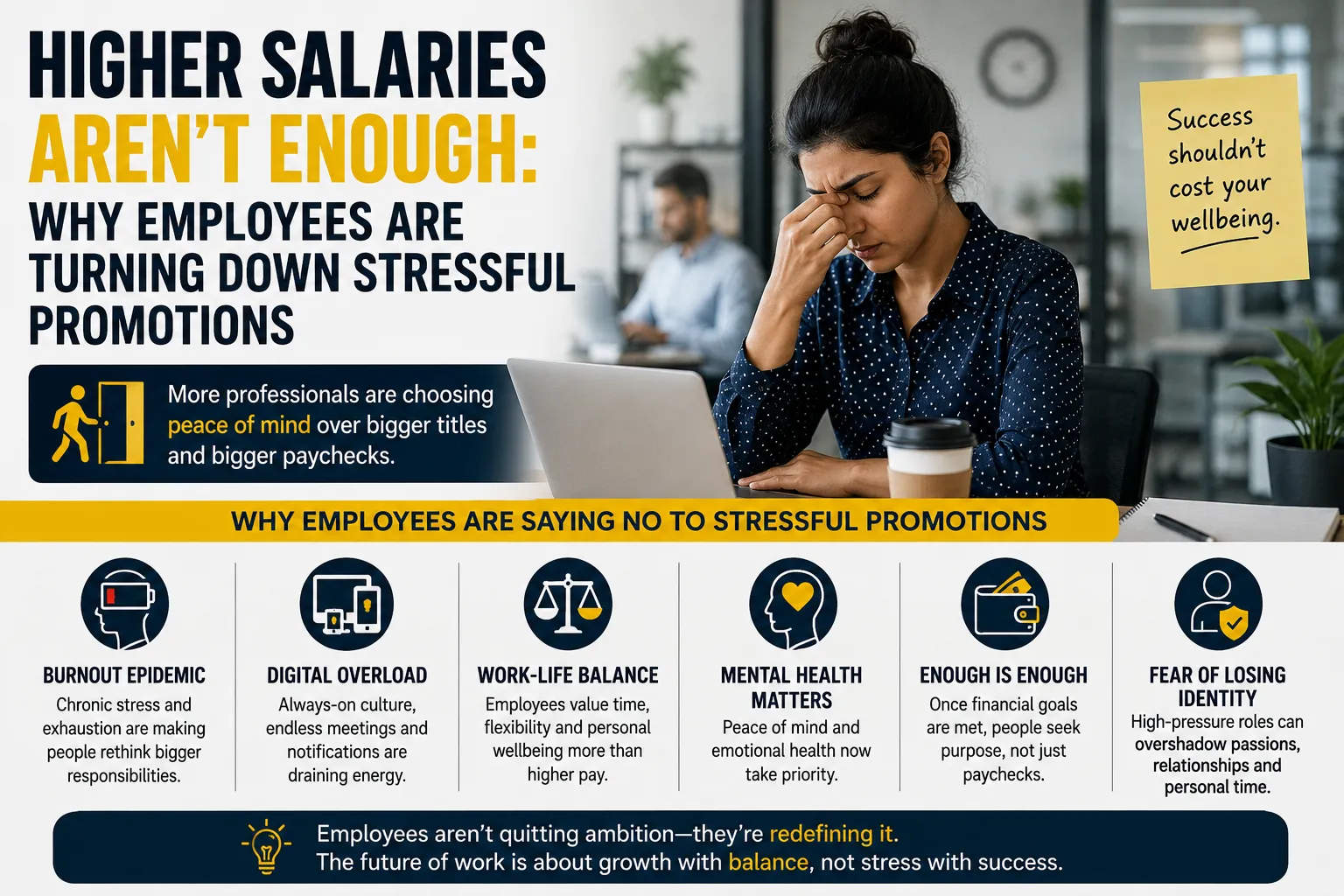
For decades, career success was largely defined by climbing the corporate ladder. Promotions, bigger titles, corner offices, and higher salaries were seen as clear signs of professional achievement. However, workplace attitudes are now undergoing a major transformation. Across industries, many employees are increasingly turning down promotions that come with excessive pressure, long hours, and declining work-life balance.
The shift reflects changing priorities in a post-pandemic work culture where mental wellbeing, flexibility, emotional health, and personal time have become as important as financial rewards. Employees are no longer automatically accepting management positions or senior leadership roles simply because they offer more money.
Recent workplace studies and employee discussions suggest that burnout, digital overload, constant connectivity, and unrealistic performance expectations are pushing workers to rethink what success truly means.
Many professionals now believe that higher salaries cannot compensate for:
-
Chronic stress
-
Reduced personal time
-
Emotional exhaustion
-
Mental health struggles
-
Loss of autonomy
This evolving mindset is reshaping workplace culture globally and forcing companies to reconsider how they define leadership, productivity, and employee satisfaction.
The Changing Definition of Career Success
Traditional corporate culture encouraged employees to constantly seek:
-
Promotions
-
Leadership roles
-
Higher compensation
-
Bigger responsibilities
Success was often measured through status, salary growth, and managerial authority.
Today, however, employees are redefining success in more personal and balanced ways.
Many workers now prioritize:
-
Flexible schedules
-
Mental wellbeing
-
Personal freedom
-
Family time
-
Job stability
-
Emotional health
The idea that professional achievement must come at the cost of personal happiness is increasingly being questioned.
Several workforce reports show that employees are becoming more selective about career advancement opportunities, especially when promotions involve significant increases in workload and stress.
Burnout Has Become a Major Workplace Crisis
One of the biggest reasons employees are rejecting stressful promotions is burnout.
Burnout refers to chronic workplace stress that leads to:
-
Emotional exhaustion
-
Reduced motivation
-
Mental fatigue
-
Cynicism toward work
-
Declining productivity
Studies show burnout levels have risen significantly in recent years due to:
-
Remote work overload
-
Constant digital communication
-
Long working hours
-
Staffing shortages
-
Economic uncertainty
A recent workforce report found that a large percentage of employees experienced increased burnout during the past year, with work-life imbalance becoming one of the biggest concerns among professionals.
Employees increasingly fear that promotions may worsen these problems instead of improving their lives.
Higher Salaries No Longer Guarantee Happiness
For many professionals, the financial benefits of promotions no longer appear worth the emotional cost.
Employees are beginning to ask:
-
Is the extra salary enough to justify losing personal time?
-
Is constant pressure sustainable?
-
Does career advancement improve quality of life?
In many cases, promotions come with:
-
Longer hours
-
Increased accountability
-
Team management stress
-
Constant availability expectations
-
Reduced flexibility
Workers are calculating that the additional income often does not proportionally improve their overall wellbeing.
Online discussions and employee forums increasingly feature professionals openly rejecting promotions because they value peace of mind more than status or title.
This shift reflects a broader cultural reevaluation of money versus quality of life.
Digital Overload Is Making Leadership Roles Harder
Modern workplaces are now dominated by continuous digital communication.
Employees today deal with:
-
Endless emails
-
Messaging apps
-
Video meetings
-
Notifications
-
Virtual collaboration tools
Leadership positions often intensify this digital overload because managers are expected to remain constantly available.
Many promoted employees find themselves:
-
Handling after-hours communication
-
Managing crises during weekends
-
Attending excessive meetings
-
Balancing administrative tasks with regular work
This “always connected” culture has significantly increased workplace fatigue.
As a result, many workers now view managerial promotions as pathways to permanent stress rather than professional achievement.
Employees Want Flexibility More Than Titles
Flexibility has become one of the most valuable workplace benefits in the modern economy.
Workers increasingly prefer jobs that allow:
-
Remote work options
-
Flexible schedules
-
Reduced commuting
-
Better work-life integration
Research suggests employees now prioritize flexibility nearly as much as salary itself.
Promotions, however, often reduce flexibility because senior roles usually require:
-
Increased oversight responsibilities
-
More meetings
-
Constant communication
-
Greater organizational visibility
Some employees therefore intentionally avoid promotions to protect the flexibility they currently enjoy.
For many professionals, maintaining control over time has become more important than climbing the corporate hierarchy.

Mental Health Is Finally Being Prioritized
Workplace mental health discussions have become far more open in recent years.
Employees are increasingly willing to acknowledge:
-
Anxiety
-
Stress
-
Emotional exhaustion
-
Depression linked to work pressure
This cultural shift has encouraged workers to make career decisions based not only on financial gain but also on psychological wellbeing.
Many professionals have personally experienced or witnessed:
-
Burnout breakdowns
-
Chronic stress illnesses
-
Emotional fatigue
-
Relationship strain caused by overwork
As awareness grows, employees are becoming more cautious about accepting roles that may negatively impact mental health.
In online career discussions, workers frequently describe rejecting promotions specifically to protect emotional stability and personal happiness.
The Rise of the ‘Enough Salary’ Mindset
Another major workplace trend is the growing idea of the “enough salary.”
Instead of endlessly chasing higher income, many employees are asking:
-
How much money is actually enough for a comfortable life?
-
Does additional income truly improve happiness?
Once basic financial goals are achieved, workers increasingly prioritize:
-
Free time
-
Family life
-
Personal interests
-
Emotional wellbeing
This mindset challenges traditional corporate assumptions that employees will always pursue more money and higher positions.
Some professionals now willingly sacrifice additional income in exchange for:
-
Lower stress
-
Predictable schedules
-
Reduced pressure
-
Greater personal freedom
This psychological shift is changing how employees evaluate career growth opportunities.
Younger Generations Are Driving the Change
Younger workers, especially Millennials and Gen Z employees, are playing a major role in reshaping workplace expectations.
These generations often place strong importance on:
-
Work-life balance
-
Purpose-driven work
-
Mental health awareness
-
Flexible environments
-
Personal fulfillment
Unlike older workplace cultures that glorified overwork and sacrifice, younger employees are more likely to question toxic productivity norms.
Many younger professionals openly reject:
-
Hustle culture
-
Excessive overtime
-
Constant availability expectations
This generational change is forcing organizations to reconsider leadership structures and employee engagement strategies.
Women Are Experiencing ‘Promotion Burnout’
Studies also show that women increasingly experience what experts describe as “promotion burnout.”
Research indicates many women feel less motivated to pursue leadership roles due to:
-
Emotional labor expectations
-
Workplace bias
-
Unequal recognition
-
Additional family responsibilities
-
High burnout risk
Reports suggest many women no longer see leadership positions as attractive because the emotional and mental demands often outweigh perceived benefits.
This trend has sparked broader conversations about workplace equality, leadership support, and sustainable career growth.
The Fear of Losing Personal Identity
Many employees also fear that stressful promotions may consume their personal identities.
High-pressure corporate roles can sometimes leave little time for:
-
Family relationships
-
Hobbies
-
Physical health
-
Social life
-
Personal development
Workers increasingly recognize that career success alone does not guarantee life satisfaction.
As a result, professionals are becoming more protective of personal boundaries and lifestyle quality.
This shift reflects a deeper cultural movement where individuals seek careers that support life rather than dominate it.
Companies Must Rethink Leadership Models
Organizations are now facing an important challenge:
How can they make leadership positions attractive without creating unsustainable stress?
Companies may need to improve:
-
Leadership support systems
-
Mental health resources
-
Workload distribution
-
Flexible management structures
-
Employee autonomy
Many experts argue that the future of leadership must focus on sustainability rather than constant overperformance.
Businesses that fail to adapt may struggle to retain ambitious talent willing to step into senior roles.
Workplace Culture Is Entering a New Era
The growing reluctance to accept stressful promotions reflects a major transformation in workplace culture.
Employees are no longer automatically equating:
-
Bigger titles
with -
Better lives
Instead, workers increasingly value:
-
Emotional wellbeing
-
Time freedom
-
Healthy work environments
-
Sustainable careers
This does not mean ambition has disappeared. Rather, ambition itself is being redefined.
Many professionals still seek growth and meaningful work — but without sacrificing health, relationships, and peace of mind.
Conclusion
The growing trend of employees rejecting stressful promotions despite higher salaries reflects a profound shift in modern workplace values. Burnout, digital overload, constant connectivity, and rising mental health awareness have caused many professionals to question whether traditional corporate advancement is truly worth the emotional cost.
Today’s workers increasingly prioritize flexibility, personal wellbeing, autonomy, and sustainable work-life balance over status and titles. Higher pay alone is no longer enough to compensate for chronic stress, exhaustion, and loss of personal freedom.
As workplace culture continues evolving, companies may need to fundamentally rethink how leadership roles are structured and supported. The future of career growth will likely depend not just on compensation, but on whether organizations can create healthier, more balanced, and emotionally sustainable professional environments for their employees.
mediyao mediyao mediyao mediyao mediyao mediyao mediyao mediyao mediyao mediyao mediyao mediyao mediyao mediyao mediyao mediyao mediyao mediyao mediyao mediyao mediyao mediyao mediyao mediyao mediyao mediyao mediyao mediyao mediyao mediyao mediyao mediyao mediyao mediyao mediyao mediyao mediyao mediyao mediyao mediyao mediyao mediyao mediyao mediyao mediyao mediyao mediyao mediyao mediyao mediyao mediyao mediyao mediyao mediyao mediyao mediyao mediyao mediyao mediyao mediyao mediyao mediyao mediyao mediyao mediyao mediyao mediyao mediyao mediyao mediyao mediyao mediyao mediyao mediyao mediyao mediyao mediyao mediyao mediyao mediyao mediyao mediyao mediyao mediyao mediyao mediyao mediyao mediyao mediyao mediyao mediyao mediyao mediyao mediyao mediyao mediyao mediyao mediyao mediyao mediyao mediyao mediyao mediyao mediyao mediyao mediyao mediyao mediyao mediyao mediyao mediyao mediyao mediyao mediyao mediyao mediyao mediyao mediyao mediyao mediyao mediyao mediyao mediyao mediyao mediyao mediyao mediyao mediyao mediyao mediyao mediyao mediyao mediyao mediyao mediyao mediyao mediyao mediyao mediyao mediyao mediyao mediyao mediyao mediyao mediyao mediyao mediyao mediyao mediyao mediyao mediyao mediyao mediyao mediyao mediyao mediyao mediyao mediyao mediyao mediyao mediyao mediyao mediyao mediyao mediyao mediyao mediyao